How Supercapacitors Eliminate Voltage Sags in AI Data Centers
AI data centers are exposing a power quality problem that traditional infrastructure was never designed to solve.
Electrical engineers have always planned for peak load, harmonics, and fault protection, but AI workloads—driven by GPU clusters with highly dynamic power profiles—are introducing millisecond-scale transients that stress upstream systems in new ways. The result is a threat more subtle than a blackout, but pose considerable downtime risks: voltage sags.
For operators responsible for uptime, voltage sags are becoming one of the most important—and least visible—constraints in AI data center expansion. This article explains why they occur, why traditional mitigation methods struggle to respond, and how supercapacitor-based systems like the C-Link™ product suite provide a modular, millisecond-response layer that complements existing infrastructure.
The AI Load Profile Is Fundamentally Different
Traditional enterprise data centers were dominated by relatively steady CPU loads. Virtualization and cloud scaling occurred over seconds or minutes, but AI workloads are different.
GPU clusters operate with:
Rapid workload ramping (training epochs, inference bursts)
High instantaneous current draw
Large power swings across racks
Tight voltage tolerance requirements
A single AI rack can swing tens of kilowatts in milliseconds. When hundreds of racks shift states nearly simultaneously, the aggregate load change can reach multiple megawatts within a few AC cycles.
What Actually Causes Voltage Sags?
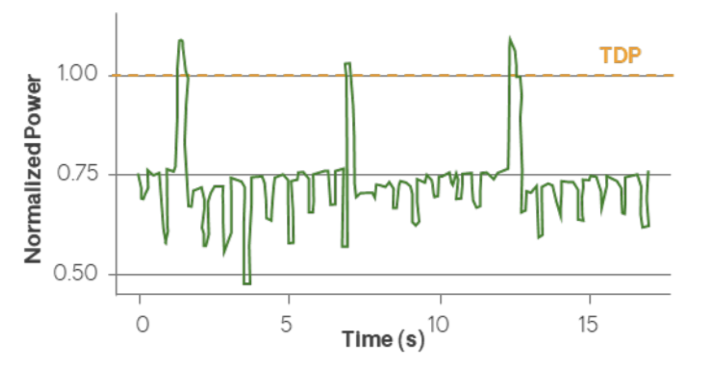
When large AI workloads ramp up, they don’t draw power linearly, but rather create sharp, sudden demand spikes. This spike paired with the inherent impedance from upstream equipment (transformers, switchgear, cabling, utility feeders) causes a temporary voltage drop, which propagates through the distribution system. This results in sensitive IT equipment seeing undervoltage conditions.
Even a 10% voltage sag lasting 3–10 cycles (50–160 ms) falls squarely within what IEEE 1159 defines as a short-duration RMS voltage variation (instantaneous sag). This can:
Trigger protective logic
Cause PSU resets
Force workload migration
Reduce power supply efficiency
Increase thermal stress
These are not “power outages.” They’re short-duration disturbances. But at AI scale, they accumulate into uptime risk.
Why Traditional Infrastructure Struggles
Modern data centers are built around multiple layers of electrical protection designed to keep power flowing. Power typically enters from the utility, passes through transformers, and is conditioned by battery-based uninterruptible power supply (UPS) systems. Behind these sit backup generators ready to take over during extended interruptions, along with static transfer switches that can rapidly shift loads between power sources without shutting systems down.
This architecture is highly effective at what it was designed to do: bridging outages that last from seconds to hours, protecting against sustained overload, and allowing equipment to ride through major electrical faults. However, it was never specifically engineered to handle high-frequency, short-duration disturbances. As a result, while these layers excel at preventing blackouts, they are far less effective at suppressing rapid transient events like the voltage sags created by sudden AI-scale power swings.
Battery-Based UPS Limitations
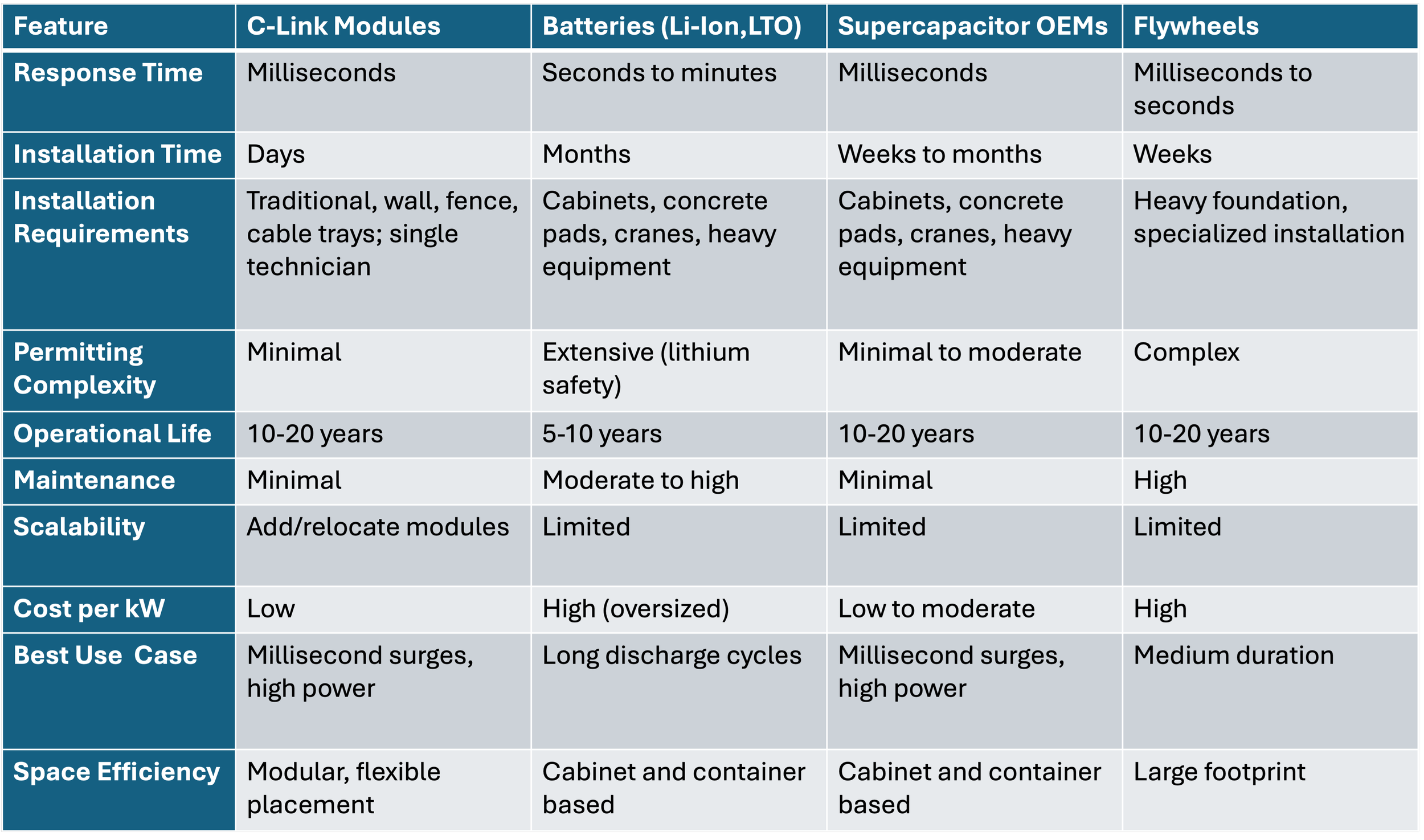
Lithium-ion and VRLA batteries are highly effective at delivering sustained energy over seconds to hours. Their strength lies in bridging outages and maintaining power continuity during longer disturbances.
However, they are not well suited for high-frequency, short-duration events. Even with fast inverters, the electrochemical response of batteries is slower than capacitive technologies at sub-cycle timescales. Frequent shallow cycling from repeated transients can also accelerate degradation, while increasing battery power density for mitigation typically requires costly system oversizing. In addition, battery installations consume valuable facility space that could otherwise support computing infrastructure.
As a result, while lithium-ion remains ideal for backup energy, it is not a particularly capital-efficient solution for high-frequency transient buffering.
The Missing Layer: Sub-Second Power Stabilization
As AI data centers continue to scale, they increasingly require a buffer between instantaneous load changed and the slower energy systems that are upstream.
This is where supercapacitor-based systems provide unique value. Unlike batteries, which store energy chemically, supercapacitors store energy electrostatically. That distinction is important: they are not intended to deliver power for minutes or hours, but rather to inject and absorb energy quickly, and to do so repeatedly without meaningful degradation.
Because of this capability, supercapacitors are particularly well suited for mitigating voltage sags and other fast transients. They also give facility designers a way to avoid oversizing battery systems — reducing capital costs tied up in backup capacity that may rarely, if ever, be fully utilized.
How C-Link™ Supercapacitor Modules Eliminate Voltage Sags
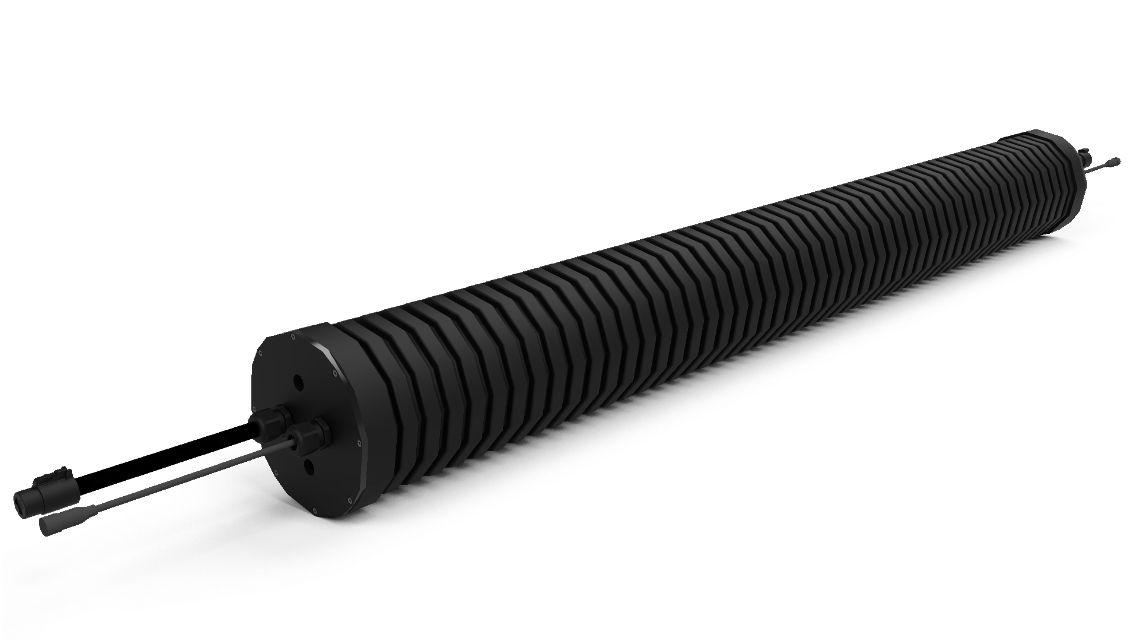
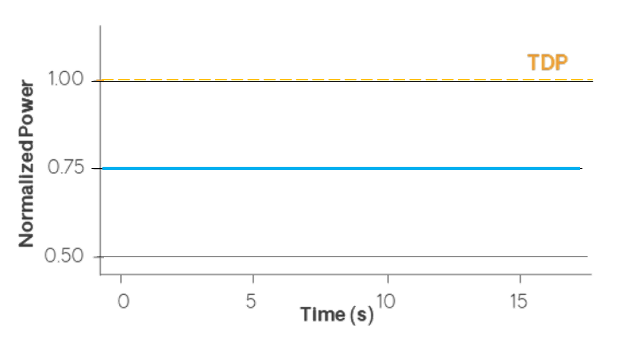
C-Link™ supercapacitor modules are designed integrate with UPS and electrical distribution systems through a DC bus or power converters, positioned close to dynamic loads or at key distribution nodes.
When a GPU cluster demands a rapid power increase:
The system’s power electronics detect the transient in real time.
C-Link supercapacitor modules discharge within milliseconds.
Local voltage is stabilized before upstream impedance causes sag.
Upstream systems see a smoother load ramp, if any at all.
This fast buffering action reduces stress on UPS infrastructure, minimizes nuisance transfers, improves power supply stability, and helps protect sensitive AI compute equipment. Importantly, it does not replace batteries or generators — it complements them by handling the ultra-fast power events they were never designed to manage.
Hypothetical Deployment Scenario: 160MW Colocation Facility
Consider a 160MW colocation data center originally designed for enterprise cloud workloads.
The facility recently leased 40MW of capacity to AI tenants. While sufficient base load capacity exists, the site was not originally engineered to handle large, fast transients from high-density GPU clusters.
Operators are concerned about:
Increased voltage sag events
Higher stress on UPS systems
Higher-than-expected battery cycling
Liability losses
Expensive demand charges from utility
Addressing the problem by expanding the upstream utility feed capacity would be complex and slow. It would likely require new substation work, long lead time (18-36 months), and significant capital investment. Replacing UPS systems with higher power-rated units would also be disruptive, involving floor space reallocation, extended downtime, major capex, and permitting challenges, especially in dense metropolitan areas.
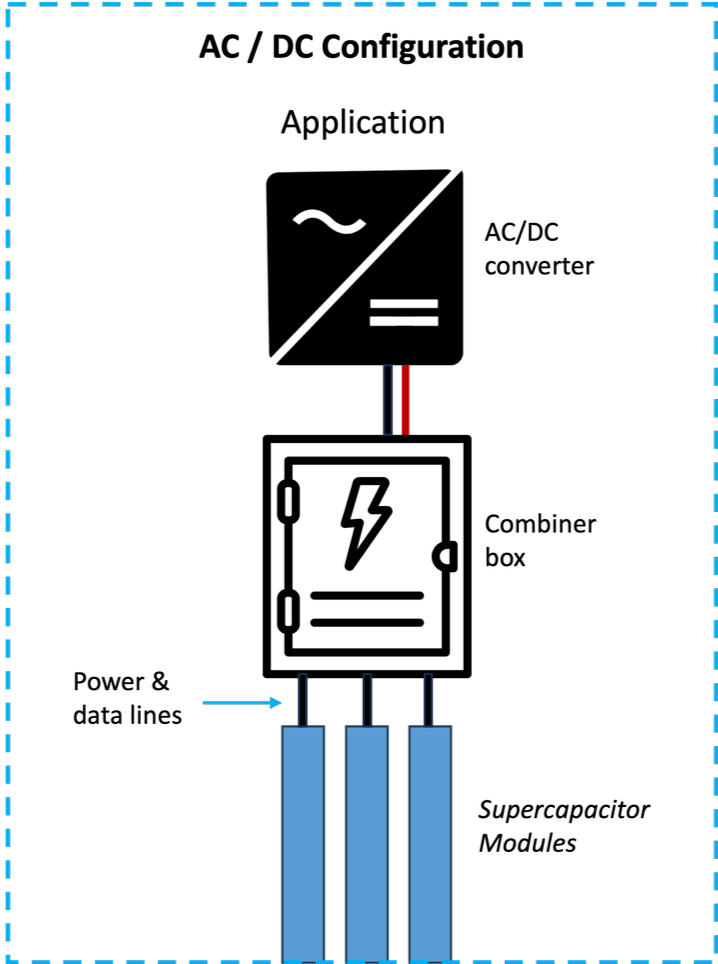
C-Link installation location. Typical AC connection is 480VAC.
Retrofit Approach Using C-Link™
Instead of pursuing large infrastructure upgrades, operators deploy modular C-Link supercapacitor units within the existing electrical architecture.
These systems are:
Installed at the 480 VAC distribution level
Sized to provide roughly two seconds of high-power transient buffering
Scaled incrementally per building module
Implementation is relatively low-impact:
No major utility redesign required
No generator modifications needed
Minimal white-space footprint due to compact design
Can be installed in phases alongside tenant expansion
Measured Outcomes (Hypothetical but Realistic):
Following deployment, operators observe meaningful improvements:
70–90% reduction in voltage sag amplitude at rack level
Significant decrease in UPS shallow-cycling and overload stress
Ability to defer costly substation expansion projects
Improved power quality metrics reported to tenants
In this scenario, C-Link supercapacitor modules do not replace batteries. Instead, they reduce the transient burden placed on them, allowing battery systems to focus on their intended role: providing reliable, long-duration backup power.
Capital Efficiency and Infrastructure Optimization
For technical decision-makers, the real question isn’t whether supercapacitors are better than batteries — it’s where each technology delivers the most value for every dollar invested.
Lithium-ion remains the clear choice for long-duration backup, where sustained energy delivery is essential. Supercapacitors, by contrast, excel at millisecond-scale transient suppression. Using them in this role can significantly improve overall capital efficiency. They typically offer a lower cost per kilowatt for short bursts of power, reduce the need to oversize UPS systems, extend battery lifespan by limiting frequent shallow cycling, and help operators avoid premature and expensive utility upgrades. Just as importantly, they allow facilities to deploy new AI capacity faster without waiting for upstream infrastructure expansion.
Deployment Speed and Engineering Practicality
AI demand is not waiting for multi-year grid upgrades. Supercapacitor systems address this gap by offering modular scalability, fast commissioning, and straightforward integration into existing distribution architectures — all with minimal operational disruption.
Because supercapacitors tolerate millions of charge-discharge cycles, they can absorb constant AI load volatility without degradation concerns typical of battery-based frequent cycling. From an engineering perspective, this creates a more stable system with fewer unpredictable maintenance variables.
It’s important to note, however, what supercapacitors are not: they are not a replacement for generators, not a long-duration backup source, and not a substitute for proper electrical system design. Instead, they serve as a high-speed buffering layer that is becoming increasingly essential in modern AI data centers.
In summary:
AI workloads create millisecond-scale load swings that traditional infrastructure was not designed to smooth.
Supercapacitors provide high-cycle, millisecond-response buffering that complements battery-based UPS systems.
A modular transient-mitigation layer can defer utility upgrades, extend battery life, and improve uptime economics.
The Engineering Conversation Ahead
As AI compute density increases, voltage sag mitigation will become a design requirement.
The most resilient data centers will adopt layered architectures:
Utility for bulk power
Batteries for long duration backup and demand shifting
Generators (gas, hydrogen, and fuel cell) for outage resilience
Supercapacitors for transient stabilization to enable traditional infrastructure to operate under steady state loads
If you’re evaluating how to integrate high-density AI loads into existing facilities, or planning new AI infrastructure, now is the time to assess whether your system has a high-speed buffering layer. Capacitech works with utility, microgrid, and data center engineering teams to mitigate transient behavior, evaluate integration points, and deploy pilot-scale C-Link™ systems that address voltage sag at its source. We welcome technical discussions, joint modeling exercises, and pilot deployments to evaluate performance under real AI load conditions.