

How Supercapacitors Prolong Equipment Lifespan for Utilities
Overview
Across grids and microgrids, aging transformers, feeders, and battery assets are being asked to do something they weren’t originally designed for: instantly respond to highly dynamic, often millisecond-scale load swings. Over time, these load swings, and the transient current spikes that come with them, increase thermal stress, accelerate aging, and shorten maintenance intervals. Supercapacitor-based power conditioning and buffering — applied at the right layer of the power stack — prevents many of those stresses before they start. Article takeaways include:
Millisecond buffer: Supercapacitor systems respond in miliseconds to absorb cycle-level spikes that otherwise stress transformers, feeders, and batteries.
Lifecycle uplift: Reducing transient demand reduces transformer hotspot temperatures and battery cycling, extending asset life and deferring capital replacement by offering a low impedance pathway to condition power through.
Targeted deployment: Modular placement at MV/LV substations or feeder nodes provides high ROI by right sizing the application, avoiding full-scale infrastructure upgrades, and lowering O&M.
Why dynamic loads accelerate equipment aging
Modern loads—industrial drives, PV inverters, and AI data centers—produce rapid, and large, current transients. Two properties matter most for equipment life:
Magnitude of transient current — instantaneous currents during a spike can be many times the steady-state current.
Repetition and duty — repeated transients produce cumulative thermal and electromechanical stress.
Effects on common utility assets:
Transformers (MV/LV): Eddy-current and dielectric heating increase with transient “surge” events, RMS current demand, and harmonics. Repeated transient heating raises hotspot temperatures, accelerating insulation aging and promoting eventual winding or bushing failure.
Feeders and cables: I²R losses during transient peaks increase conductor heating and mechanical stress on connectors; repeated peaks can increase resistance over time.
Batteries and UPS: Batteries supplying frequent short, high-power pulses experience high C-rates, elevated internal temperatures, and premature capacity fade—especially if they’re intended for longer-duration discharge rather than high-power cycling.
These effects change maintenance schedules, de-rate equipment earlier, and increase both capital and operating spend.
How supercapacitors interrupt the damage pathway
Supercapacitors have a high power density, ultra-fast response, and very simple charge/discharge characteristics. Placed at MV/LV substation points or at feeder nodes, supercapacitors can act as a front-line buffer—absorbing and supplying energy on cycle-level timeframes. When supercapacitor systems are placed between the source of the transient fluctuations (like large ramping loads or variable generation) and the transformers or feeders, they reduces the peak current that must flow through the transformers and feeders during spikes and prevents batteries from repeatedly taking short, damaging pulses. Additionally, they require minimal maintenance operating on the order of 500,000 to 1,000,000 cycles.
Transformers & Feeders
A supercapacitor system can, through a bidirectional AC-DC power converter, reduce transient RMS current and harmonic content at the fundamental frequency (50/60Hz) seen by transformers and feeder cables. Even shaving short-term peak demand by 10–25% can reduce hotspot temperature and slow insulation aging noticeably in life-cycle models. That avoids or defers expensive infrastructure upgrades.
Batteries
By handling cycle-level events, supercapacitors relieve batteries of high rate, short-duration duty, reserving them for demand shift, arbitrage markets, and outage bridging. The outcome: extended battery cycle life, fewer replacements, and lower long-term lifecycle cost.
Practical deployment considerations
Supercapacitor systems (like C-Link™) are typically AC-coupled at distribution points or DC-coupled within renewable energy infrastructure.
Connection point: at MV/LV substation secondary bus to protect transformers or before feeder sectionalizing points to maximize effect on local transformer loading.
Coordination: designed to complement—not replace—existing battery systems and generators and simplify demand ease control and coordination. Power electronics in AC-DC or DC-DC converters interface to ensure smooth sharing of demand and avoid control conflicts.
Form factor: modular units that mount in available equipment rooms, outdoors enclosures, walls/fences, or on existing cable trays—reducing installation work compared to large battery rooms.
Quantitatively, because our supercapacitor modules can be deployed in many small increments, you can right-size transient mitigation capacity without committing to broad infrastructure upgrades.
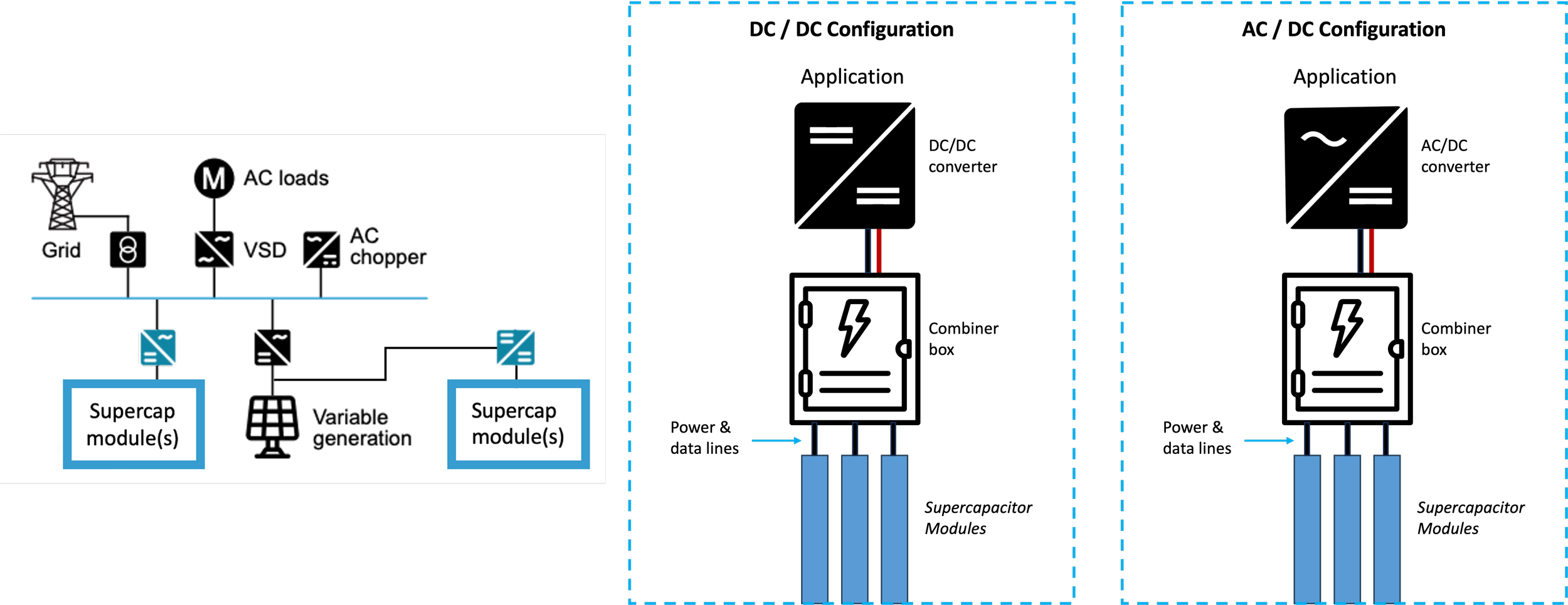
Hypothetical retrofit: MV feeder serving mixed industrial and renewable loads
Context: An MV/LV substation (15/0.4 kV) in a mixed industrial park has an aging transformer running close to capacity, a feeder serving manufacturing loads with variable motor starts, plus a 2 MW rooftop PV array. Utilities are seeing frequent transient alarms, high transformer temperature swings, and accelerated maintenance requirements.
Conservative engineering fix options: Replace the transformer with a higher-rating unit and reconductor feeders — lead time 9–18 months, high capex, permitting and civil works.
Alternative, targeted retrofit using supercapacitors:
Install a C-Link supercapacitor system connected to the substation secondary through a bidirectional AC-DC converter.
Configure control to regulate voltage and frequency; absorb PV ramp events, downstream transformer and motor start inrushes, providing cycle-level support during peaks.
Expected outcomes:
Measured transient peak current through transformer reduced by ~30–45% during worst events.
Transformer hotspot temperature excursions reduced by several degrees C, extending projected insulation life by years (model-dependent).
Deferral of transformer replacement and feeder reconductoring for multiple years — reducing immediate capital outlay and disruption.
Reduced battery shallow cycling and lower long-term battery replacement costs.
This targeted approach lets utilities buy time to schedule larger upgrades strategically rather than reactively.
Conclusion
Aging infrastructure and faster, more dynamic loads are a fact of modern grids and microgrids. Supercapacitor systems are a practical engineering lever that reduces equipment stress to extend operating life, and improves capital efficiency — while integrating with long duration energy storage assets, generation, and grid management systems.
If you’re assessing transformer or feeder health, planning upgrades, or modeling transient behavior in mixed renewable and industrial environments, let’s run a joint analysis or pilot. We’ll be your partner in evaluating use cases and seeing a solution through to deployment.
Contact our engineering team to start a technical discussion or propose a pilot project.