

Capacitech CEO Joe Sleppy recently joined Richard Bilbao, Editor-in-Chief of the Orlando Business Journal, on the Florida Business Minds podcast. They discussed why power matters to business infrastructure as Florida grows, what data center demand means for the grid, and how modular supercapacitor systems act as a shock absorber for power infrastructure.
In this post, we’re picking up one thread from that conversation: power systems need both sprinters and marathon runners.
Listen to the full episode · Read the OBJ feature
The problem is not only how much power. It is how fast.
Most power infrastructure was designed around steady demand and long-duration events. Utility service, generators, and UPS batteries are built to carry load for minutes or hours, and to bridge outages.
Today's loads behave differently. AI workloads can surge 30–50% above baseline for 0.2 to 2 seconds at a time. Large motors draw inrush current at startup. Fleet EV charging and intermittent solar create rapid swings in supply and demand.
These events are short, but they are frequent. Each one stresses equipment that was never designed to respond on a millisecond timescale. The result is voltage sags, nuisance alarms, accelerated wear, and in some cases downtime.
The marathon runners: batteries, generators, and the grid
Batteries, generators, and grid connections are the marathon runners of the power system. They deliver energy over long periods and remain essential for backup, energy shifting, and bulk supply.
Problems start when marathon runners are asked to sprint:
Batteries sized for peak power instead of energy force a trade-off. Either optimize chemistry for power and give up runtime, or oversize the system and pay for capacity you will never use. Frequent shallow cycling from transients also accelerates degradation.
Generators sized for instantaneous spikes rather than sustained demand cost more, take more space, and often run less efficiently.
Grid upgrades to absorb peak demand can take years and significant capital.
The sprinters: supercapacitors
Supercapacitors store energy electrostatically rather than chemically. That difference defines their role.
They respond in milliseconds, deliver high power density, and tolerate more than 1,000,000 charge and discharge cycles. They are not designed for hours of runtime, and they should not be. Their job is to handle the fast, repeated events that fall between instantaneous load changes and the slower response of upstream systems.
Better together
When each technology runs in its own time domain, the whole system performs better:

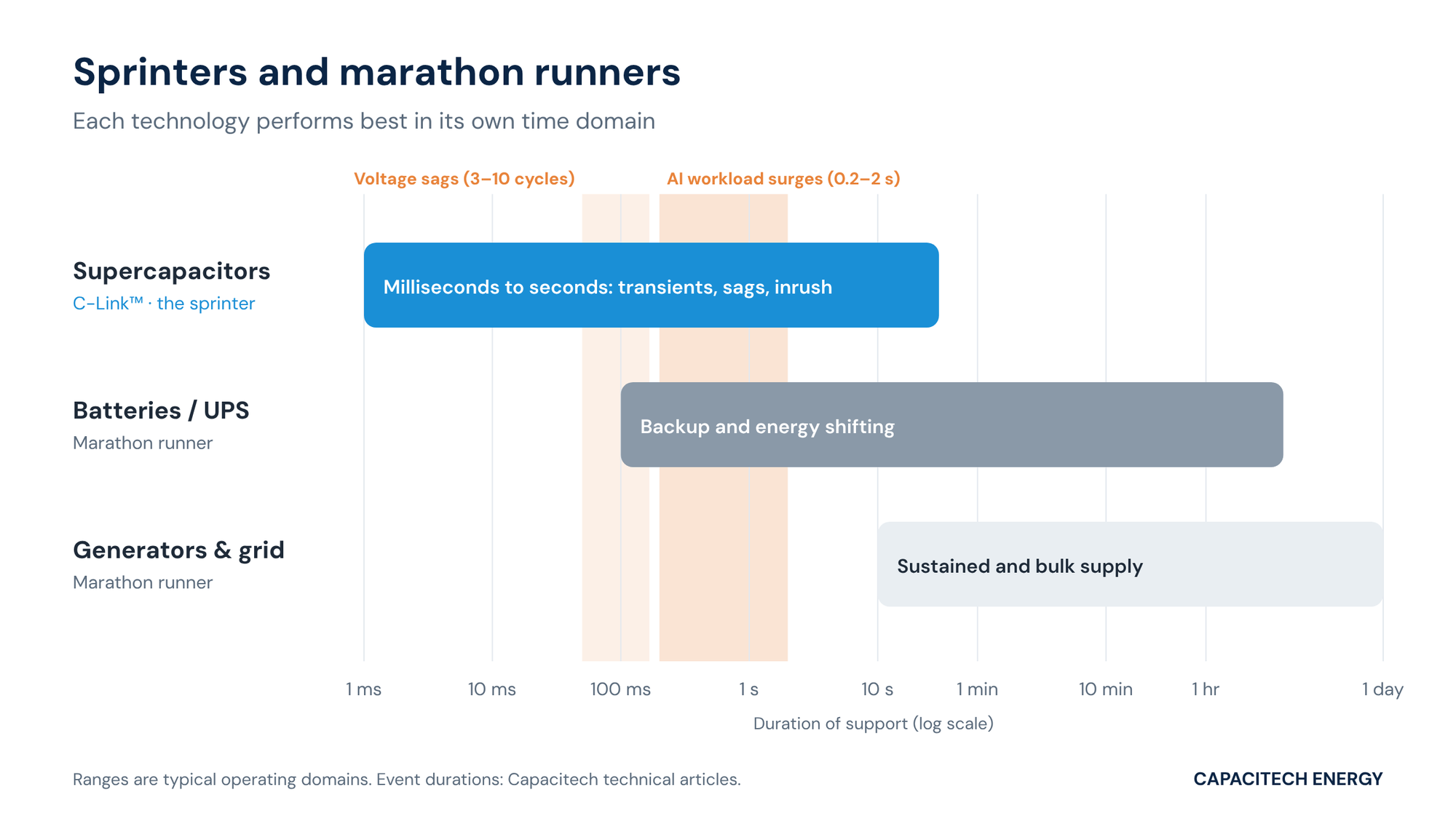
With a sprinter layer handling transients, generators can be sized for steady demand, batteries can focus on duration, and upstream equipment sees a smoother load. In a data center, AI loads begin to look electrically like the traditional loads the existing infrastructure was designed to serve.
Data center concerns: where they have merit, and what is missing
The concerns about data center power demand are real. Load growth is outpacing interconnection timelines in many markets, and when grid capacity lags, projects turn to on-site generation to stay on schedule. Communities notice.
What is often missing from the conversation is how much of that infrastructure is sized for transients rather than average energy. A meaningful share of overbuild comes from designing around worst-case spikes. Adding a high-speed buffering layer lets operators get more from the assets they already have, rather than simply adding more megawatts.
That is why Capacitech works alongside onsite power providers serving data centers. Pairing supercapacitors with generation and storage helps projects move faster without oversizing every layer of the system.
Making supercapacitors practical
Supercapacitor technology has been proven for years. The challenge has been deployment. Legacy systems rely on cabinets, concrete pads, and lengthy construction.
Capacitech's C-Link™ systems are fully integrated and modular, with power management, enclosure, and plug-and-play connectors built in. Modules mount on walls, fences, or cable trays, and a single technician can install them in days. Systems start small and expand as demand grows, or modules can be relocated between sites as needs change.
Continue the conversation
The future grid will not be built by marathon runners alone. It needs sprinters too, placed where they create the most value.
Listen to Joe's full conversation on Florida Business Minds, and read the Orlando Business Journal feature.
If you are evaluating how to handle dynamic loads, inrush, or power quality at your facility, our engineering team welcomes a technical discussion. Share your load profile and constraints, and we will tell you whether supercapacitors are the right fit.
