AI Workloads Are Redefining Data Center Power Quality
Why success is measured in milliseconds, not just megawatts.
Author: Capacitech Energy Date: April 21, 2026 Read time: 6 min
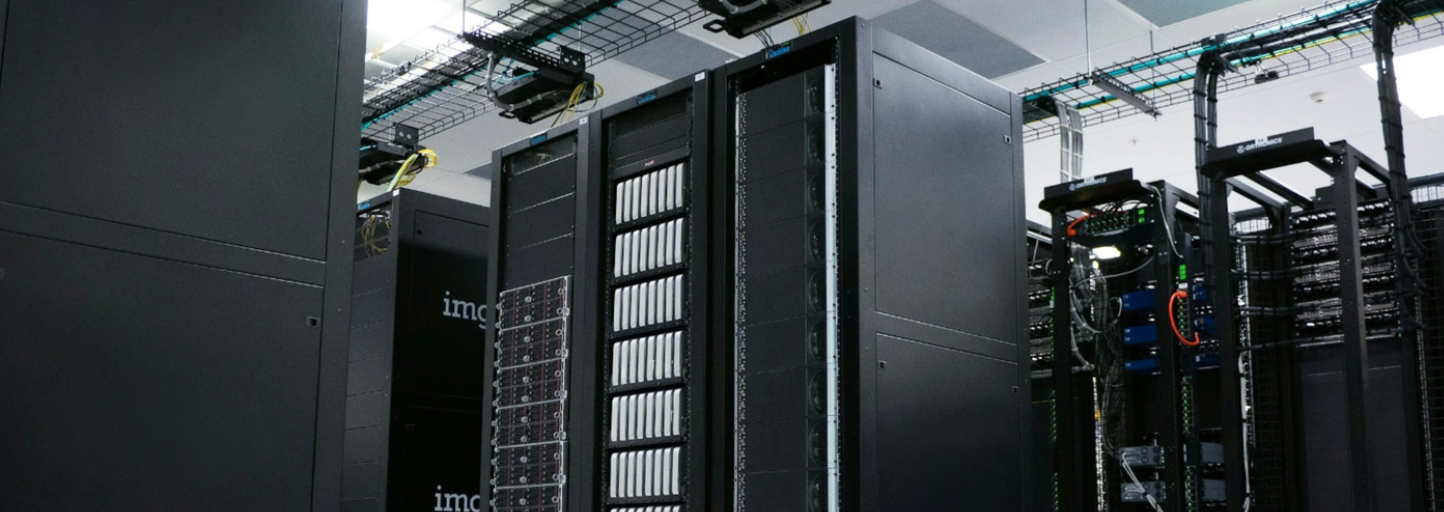
A modern AI data hall. The electrical room behind this floor still runs on a twenty-year-old power topology.
In this article
The traditional Stack and Its Limits
Where our C-Link Supercapacitor Fits
A Practical Comparison
Deployment Breakdown
Takeaways
AI is not just another IT load. It's so different, data centers are being completely redesigned to support them in terms of cooling, rack design, and every layer of power infrastructure. Today success requires more than just a utility feed landing on switchgears, passing through a UPS, and distributing to racks. It's more than just a standby generator covering extended outages with batteries. This architecture works well when the load profile is more or less steady state, AI is not.
AI training and inference replaced the steady state load profile with a dynamic one. A single GPU training run produces demand swings of 30% to 50% above its baseline in windows as short as 0.2 to 2 seconds. Inference workloads cycle more aggressively as queries pulse through clusters. These transients are the new normal inside any facility running AI workloads.
| Capacity alone does not guarantee power quality
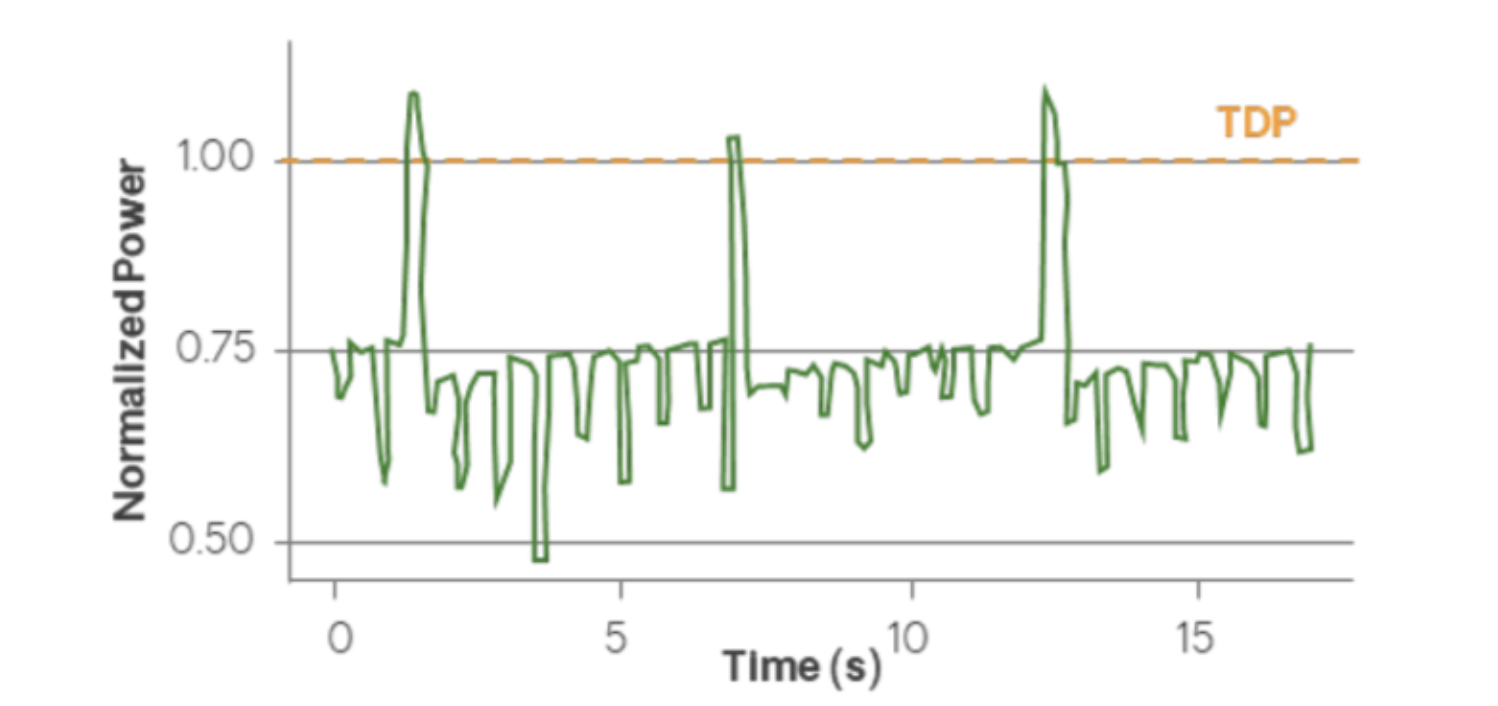
AI workloads swing between full TDP and partial load in seconds. The dips and spikes are what upstream UPS, generators, and utility regulation are not sized to handle at millisecond speed.
The Traditional Stack and Its Limits
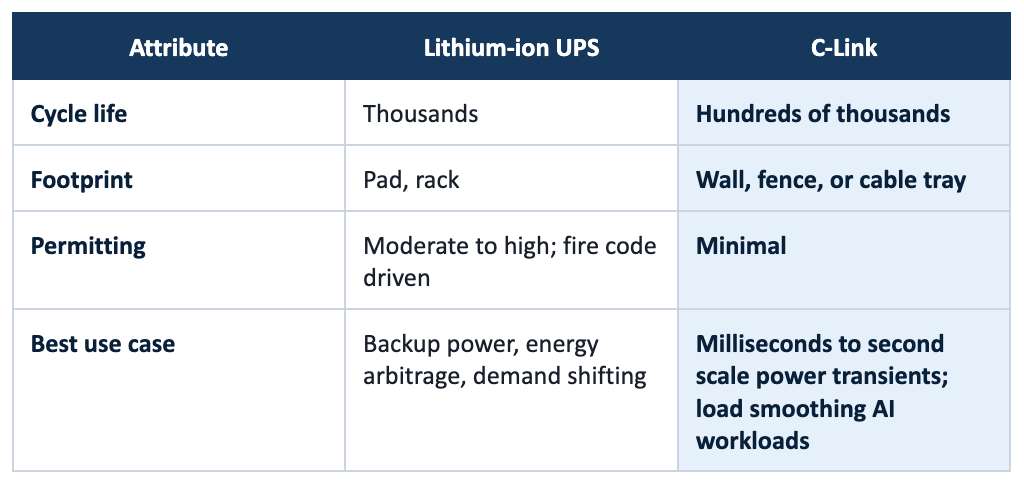
Lithium-ion UPS systems carry the load during a utility outage and bridge to onsite generation. They are energy dense and well understood, but were not optimized for repeated millisecond bursts. Cycle life at high C-rates results in degradation. Thermal management adds complexity and floor space. Permitting is slow.
Generators face a different problem. They are designed for steady-state output, not rapid load-following. When AI workloads swing power demand in sub-second intervals, generators cannot ramp fast enough to track those changes. Attempting to follow these swings causes mechanical stress on the engine and governor, accelerates wear, and shortens lifespan. The alternative is to oversize the generator so the swings represent a smaller fraction of its rated capacity. That means running the unit at roughly 50% load or less, far below the 75% to 80% sweet spot where diesel and gas generators operate most efficiently. The result is higher fuel consumption per useful kilowatt and faster carbon buildup from chronic underloading.
None of these assets are wrong. Each was scoped for problems defined in an earlier era. The gap they leave is narrow: a response window measured in milliseconds, at high power, repeated thousands of times per day, without draining long-duration storage.
Where C-Link Supercapacitor Modules Fit
Supercapacitors complement the existing stack, enabling it for AI workloads. They do not replace the UPS, generator, or utility feed. They sit between each layer of the power stack, absorbing fast transients the rest of the system was never built to catch.
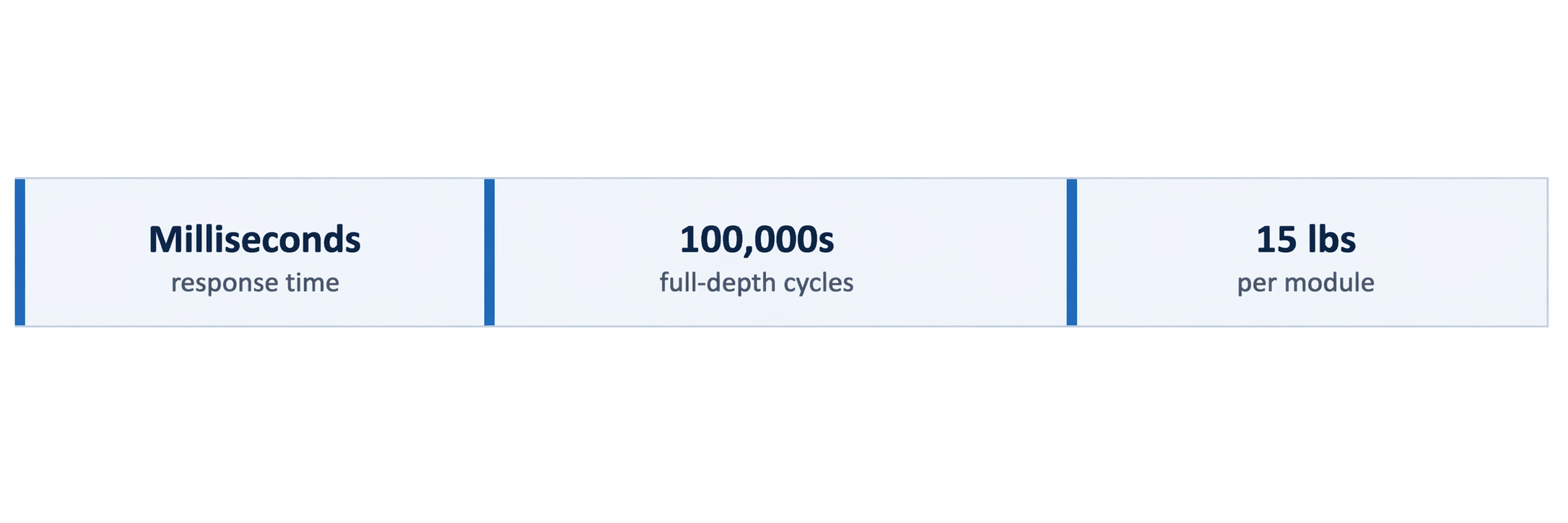
Capacitech’s C-Link supercapacitor responds in milliseconds and ready for hundreds of thousands of cycles. Each module weighs 15 pounds and operates across a temperature range of -40 to +65 degrees Celsius. Modules mount on walls, fences, or existing cable infrastructure - perfect for retrofit projects. Installation is a single-technician task measured in days, not months. No concrete pads. No cranes. No structural reconstruction.
The goal is not to eliminate the UPS or its stored energy. You still need that energy to ride through an outage. The goal is to stop oversizing the UPS to handle peak transient power that only lasts milliseconds. When operators size a UPS for the worst-case spike instead of the sustained load, they end up buying energy storage capacity that goes unused. C-Link supercapacitors absorbs the spikes so the UPS stays sized for what it does best: bridging outages until the generator picks up.
A Practical Comparison
These are engineering trade-offs. A battery is the right answer for hours of runtime. A supercapacitor is the right answer for millisecond and second scale power transients affecting power quality. Both batteries and supercapacitors belong in a modern facility.
Deployment Breakdown
Most colocation operators do not have full control over tenant IT loads. They know the power allocation, but not the equipment connected to it. That is what makes AI deployments risky for existing infrastructure.
A colocation facility with 30MW of IT capacity is already in operation across six halls. An anchor tenant starts to deploy AI workloads across two of those halls. Projected load adds 3MW of peak draw, exceeding the connected UPS’ capacity.
A C-Link supercapacitor system changes the approach from upsizing the UPS capacity (very difficult given permitting challenges and space constraints in an existing facility). C-Link supercapacitor modules install on walls in the electrical room supporting the two affected halls, sized to the transient profile of the new racks. The existing UPS continues to handle outage ride-through. The utility feed stays unchanged. Project timelines accelerate and capex stays bound to the actual problem.
If the tenant expands, modules add to the system without replacing the core system. If the tenant leaves, C-Link supercapacitor modules relocate to the next hall needing them.
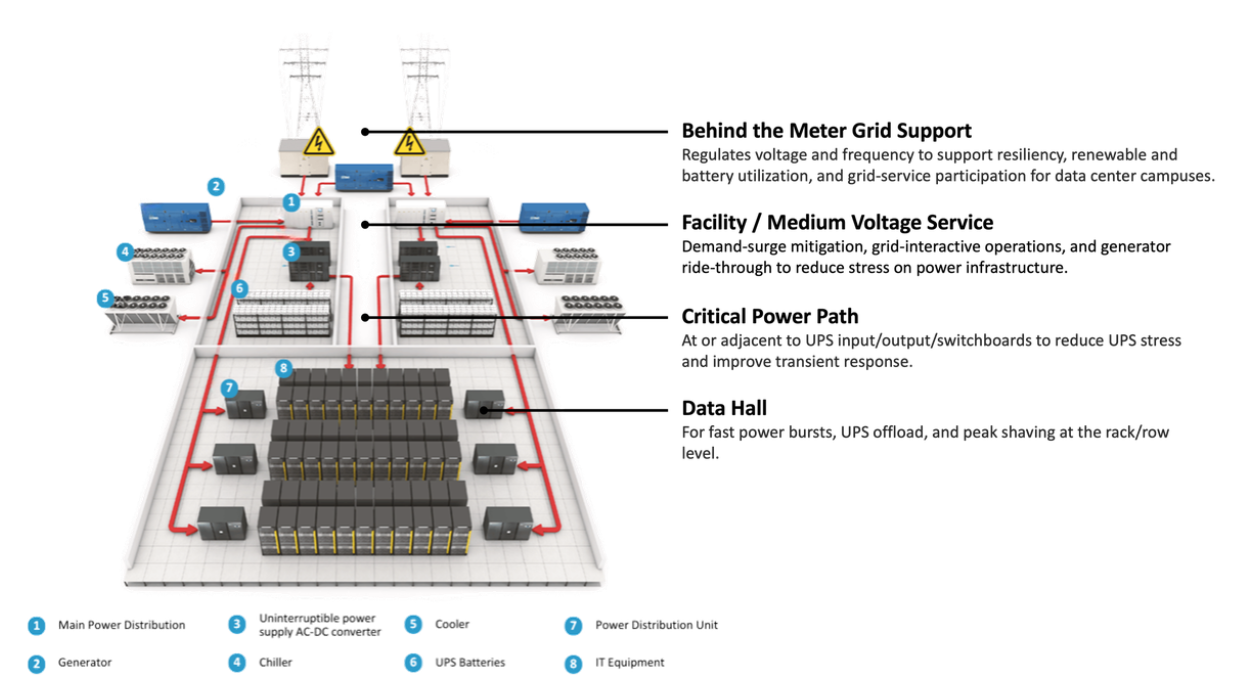
C-Link supercapacitor modules install at or adjacent to UPS input and output switchboards, and at the rack or row level. The layer adds millisecond response without replacing upstream assets.
Takeaways
C-Link supercapacitor modules complement UPS systems and onsite generation. They cover the millisecond demand UPS and generation was not sized for, extending asset lifespan and improving capital efficiency
Form factor drives deployment speed and frees up space. Wall, fence, and cable-tray mounting removes the need for concrete pads, and cranes. Being lithium-free permitting delays are avoided and projects accelerate. Because C-Link supercapacitor modules mount on vertical surfaces and existing cable infrastructure, they do not require floor space allocated to existing infrastructure.
Modularity protects capital and matches investment to actual demand. Start with the number of modules required for the current transient load in the affected halls. As the tenant scales AI workloads or new tenants bring similar profiles online, add modules to the system without rearchitecting the electrical backbone. If a tenant downsizes or leaves, those same modules physically relocate to another hall or facility where the need exists. There is no stranded capacity. Every dollar deployed stays tied to a live workload, and the operator avoids committing to a large upfront buildout based on demand projections that might not materialize for years.
Closing
The AI buildout is rewriting how data centers are built and operate. Traditional assets still carry the long-duration and outage duties they were built for. The millisecond gap is where most facilities sit exposed today, and it is the gap a C-Link supercapacitor fills without overbuilding the rest of the system.
Book a 30-minute technical review to see whether a C-Link supercapacitor module installation fits your load profile. Send a one-line diagram, a load profile, and your space constraints. We return a sizing, placement plan, and deployment schedule within a week. Pilot programs are open for qualified facilities.
Book a 30-minute technical review
Configure a C-Link supercapacitor system for your load profile.
