

As AI adoption accelerates, U.S. electricity demand is growing at a pace not seen in decades, and data centers are a major driver. While large-load customers work with utilities to secure capacity, a less visible challenge is emerging: smaller industries, from regional logistics hubs and municipal services to mid-sized manufacturers, are finding it harder and slower to get the grid capacity they need to build or expand.
The Large-Load Squeeze on the Power Grid
According to a 2024 report from Lawrence Berkeley National Laboratory commissioned by the U.S. Department of Energy, data centers consumed about 4.4% of total U.S. electricity in 2023. Depending on how quickly AI deployment continues, that share is projected to reach between 6.7% and 12% by 2028. Utilities are working to keep pace, and in many regions, connecting new large commercial and industrial loads can now take years as transmission and substation upgrades queue up.
For smaller industries, these delays can be costly. Commercial and industrial operations depend on reliable, high-capacity grid connections, whether to run heavy machinery, large-scale refrigeration, or process equipment. When local transmission or substation capacity is already committed to large new loads, smaller businesses can face significant delays in opening new facilities or expanding existing ones.
The Rise of On-Site Power Generation
Faced with interconnection delays and grid congestion, more businesses are exploring behind-the-meter (BTM) power to get facilities online on their own timeline.
On-site natural gas generation: Facilities with pipeline access can fuel on-site reciprocating engines or turbines, reducing or eliminating dependence on a new grid connection.
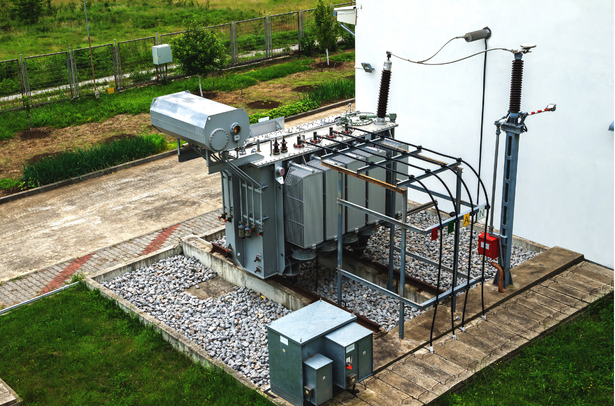
Dedicated on-site transformers and switchgear: On-site generators typically produce power at low or medium voltage. Dedicated transformers and switchgear match generator output to the facility's distribution voltage and give operators direct control over their power system.
Industrial microgrids: By combining solar, on-site generators, and energy storage under a common control system, facilities can operate independently of the grid or alongside it.
The Microgrid Challenge: Buffering Dynamic Loads
On-site generation solves the interconnection delay, but it introduces a new problem: power quality and dynamic load management.
Many industrial operations run equipment with highly variable, intermittent loads. When a large motor starts on an assembly line, a compressor or commercial HVAC system kicks on in a warehouse, or a welding cell cycles on a production floor, it draws a sharp surge of inrush current. A strong utility grid absorbs these surges far more easily. On an isolated microgrid with limited generation inertia, the same spikes can cause deep voltage sags, trip generator protection or upstream breakers, and disrupt sensitive automated equipment.
The Solution: Pairing On-Site Generation with C-Link™ Modules
To stabilize on-site microgrids, Capacitech's C-Link™ supercapacitor module is purpose-built for the job. Engineered for high-power, intermittent, and dynamic applications, C-Link is a fully integrated supercapacitor system that responds in milliseconds to absorb and release transient power before it propagates upstream.
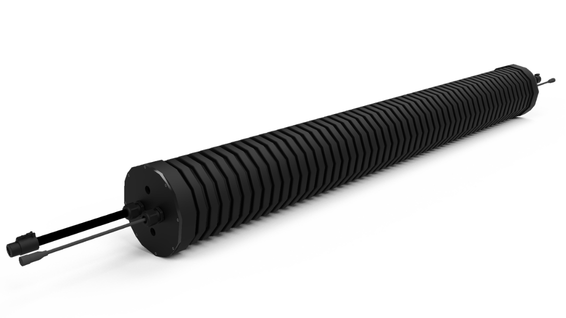
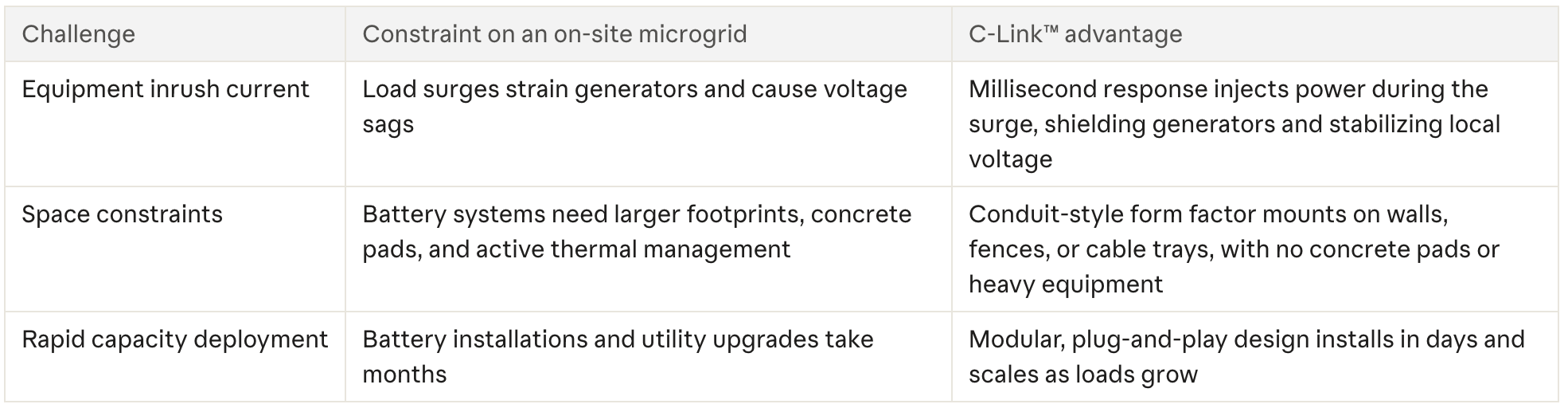
C-Link does not replace generation or long-duration storage; it complements them. By handling the millisecond-to-seconds power buffering a microgrid needs, C-Link reduces stress on generators and transformers and lets base generation run closer to steady state, improving efficiency and extending equipment life.
Conclusion
Rapid load growth is changing how smaller industries access electricity. For many businesses, waiting years for new grid capacity is becoming a strategic risk. By adopting on-site generation and pairing it with fast-acting power buffering like C-Link™ supercapacitor modules, smaller industries can bring facilities online on their own timeline while maintaining the power quality their operations depend on.
