The Greenfield Alternative: Retrofitting Legacy Colocation Facilities for AI Workload Transients
The era of the predictable, steady-state data center is officially over. From massive LLM training clusters to rapid-fire inferencing, incoming AI workloads are fundamentally rewriting the data center's power blueprint. Colocation facilities are no longer just planning for steady-state continuous loads. They are now dealing with massive, instantaneous transient power spikes that threaten power quality and damage infrastructure assets.
AI workloads create unique power surges that spike as high as 50% above baseline IT loads. These surges are short, often lasting anywhere from 0.2 to 2 seconds, sharp, and cyclical. When thousands of GPUs surge to full load simultaneously, this sheer rate of change does more than stress the underlying power infrastructure—it can exceed the rating of traditional UPS systems, placing heavy stress on the upstream infrastructure when in bypass mode.
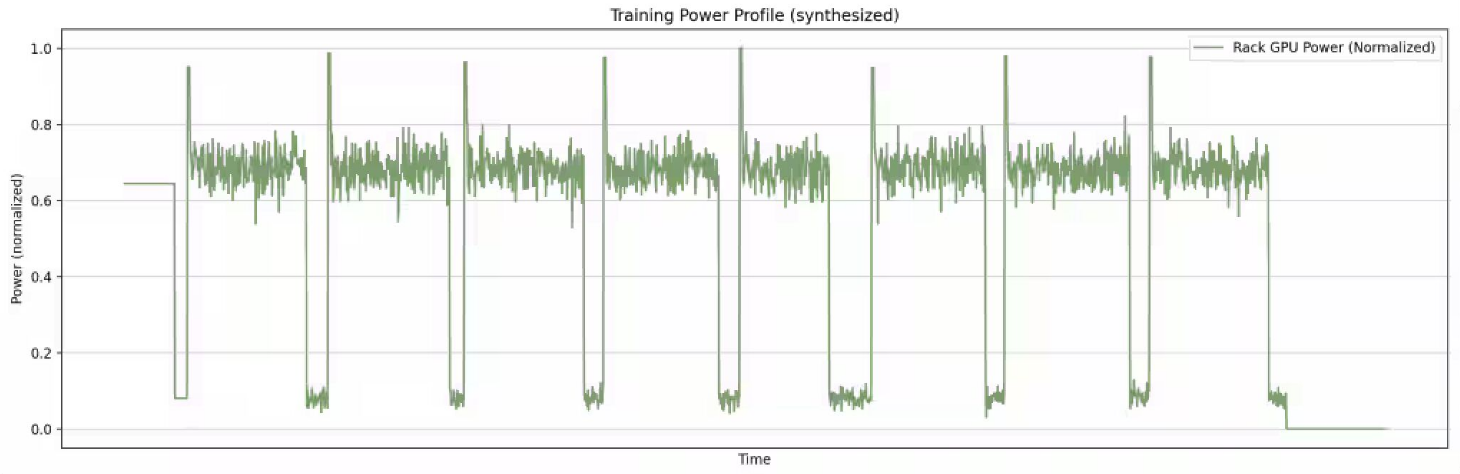
Shown Above: AI Load Profile provided by DG Matrix
The Retrofit Dilemma for Colo Engineers
For new greenfield builds, engineering around these transients is a matter of upfront capital. But for colocation providers looking to accommodate AI workloads in existing facilities, a retrofit solution is needed.
Expanding traditional battery UPS systems to absorb these transients is not an optimal solution. Not only is it capital inefficient on a dollar-per-kilowatt basis, but physical space in a colo facility commands a strict premium. Unless space has been reserved for expansion, traditional UPS and battery cabinet expansions require construction and long permitting cycles.
C-Link: Engineering for the Transient, Not the Baseline
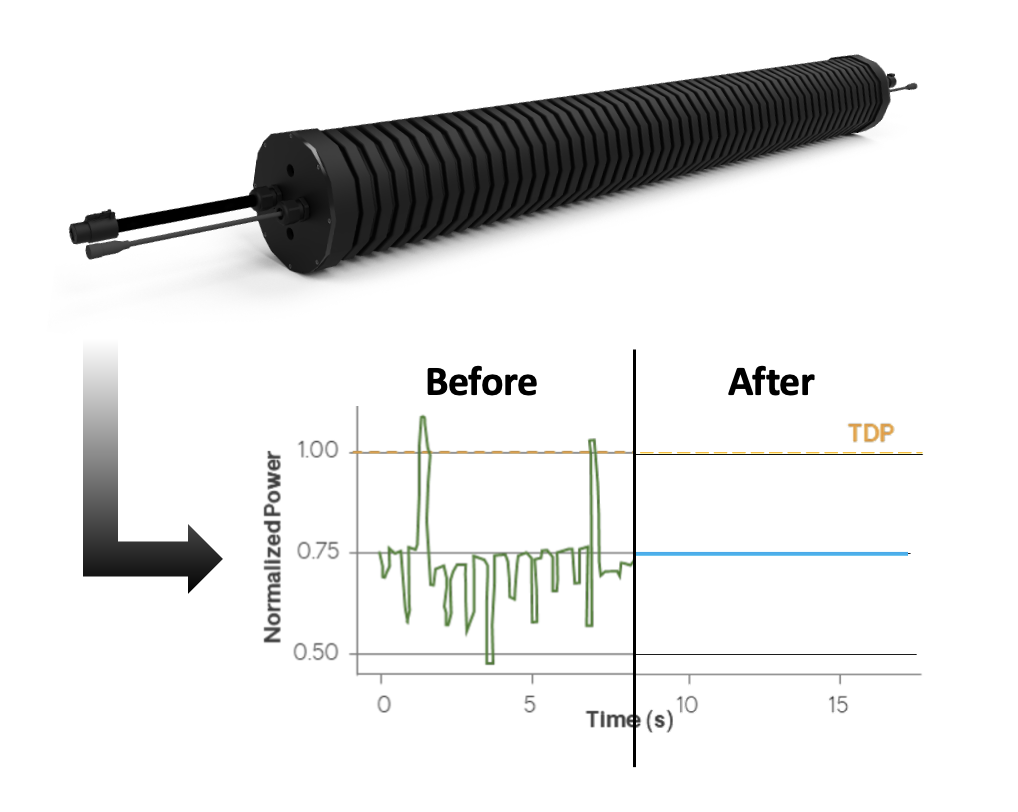
Capacitech C-Link supercapacitor modules regulate power to smooth AI load profiles
This is where Capacitech’s modular C-Link supercapacitor system fundamentally alters the retrofit strategy.
C-Link systems provide a fully integrated power conditioning solution. They are not a 1:1 replacement for UPS battery strings. Instead, they complement the existing infrastructure by acting as a dedicated buffer for transient events.
Here is the technical reality: Supercapacitors possess a dramatically lower internal resistance compared to chemical batteries (VRLA or Lithium-ion). When a sub-second AI workload surge demands an immediate power draw, a C-Link module responds in milliseconds with minimal voltage drop. This offloads the high-power transient burden from the UPS batteries and upstream infrastructure (like reciprocating engines and gas turbines), allowing legacy infrastructure to seamlessly handle the steady-state demand without localized power quality issues.
Why C-Link is the Ultimate Retrofit Solution
For facility engineers and capacity planners, C-Link solves the physical and operational constraints of brownfield upgrades:
Alternative Form Factors & Zero Floor Space: C-Link modules do not require traditional footprint-heavy cabinets. They can be mounted on walls, structural columns, fences, or directly in cable trays, deploying megawatts of transient surge protection into an existing colo hall or electrical room without sacrificing a single tile of leasable white space.
Tool-Free, Modular Scaling: Modules feature pre-installed, tool-free plug-and-play connectors. Connect them in series and parallel to meet precise voltage and current requirements. As tenant AI adoption grows, operators can simply plug in additional modules.
Rapid Deployment: Typical lead times for a C-Link system is 3 months. Combined with single-technician installation that bypasses major facility reconstruction, colos can achieve AI-ready status quickly.
High Cycle Life: Rated for over 1,000,000 cycles and wide temperature operations (-40°C to 65°C), the lifecycle drastically outpaces high-rate discharge batteries in transient environments.
Capital Efficient: Supercapacitors offer an optimized dollar-per-kilowatt profile for short-duration surges, making them highly cost-effective for smoothing recurring AI load profiles.
Rethinking Colo Power: Applying C-Link in Existing Facilities
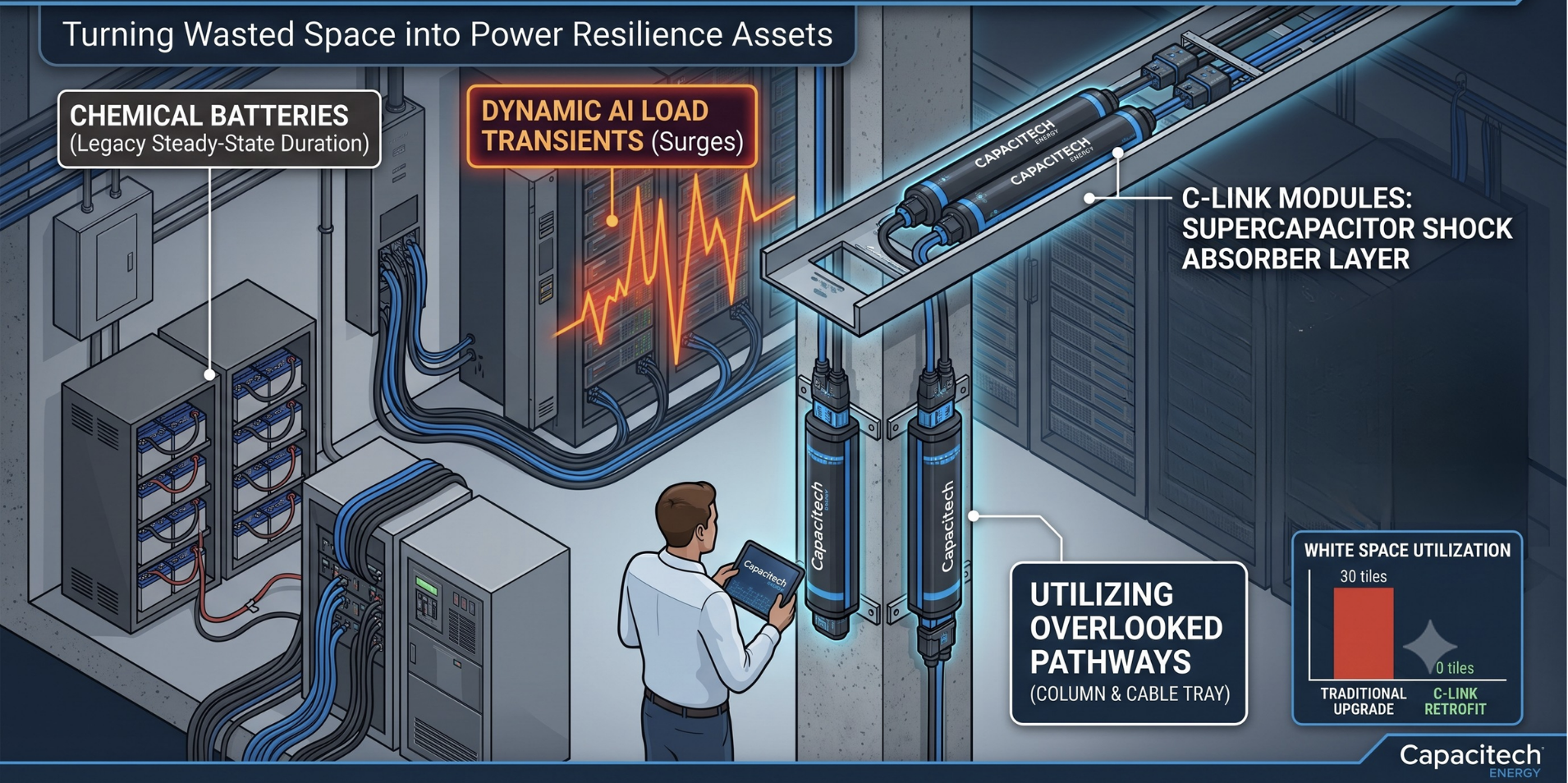
AI-generated graphic shown to demonstrate how C-Link modules can be installed on walls and inside cable-trays to optimize space.
C-Link systems are engineered to complement UPS infrastructure and steady-state sources. Consider these two primary retrofit scenarios:
1. Complying with Ride-Through Regulations and Minimizing Utility Penalties
AI power fluctuations can slip past UPS systems to the utility grid, triggering severe demand charge penalties for the facility. Furthermore, if a facility operates an aggregate peak demand over 75MW, it faces emerging voltage and frequency ride-through operating guidelines like ERCOT’s NOGRR 282. C-Link systems act as a high-speed peak shaver at the sub-cycle layer. The supercapacitors absorb the millisecond spikes, keeping the primary UPS system from entering static bypass mode and ensuring the utility feed remains flat.
2. Battery Life Extension in Legacy UPS Plants
In facilities running large strings of VRLA or lithium-ion batteries, the constant micro-cycling caused by variable AI workloads accelerates cell degradation and forces early, unexpected replacement. The C-Link system shields the UPS batteries from these dynamic transients. The supercapacitors handle the high-frequency transients, preserving chemical batteries strictly for total loss-of-mains energy backup.
Moving Forward
As colocation providers compete to attract top-tier AI and hyperscale workloads, the ability to adapt legacy infrastructure without commencing heavy civil construction is a massive competitive advantage. C-Link supercapacitor systems provide engineers with a targeted, modular, and space-efficient tool to isolate and manage transient AI loads.
By addressing power surges at the millisecond level, colos can safely increase density, customer-proof existing infrastructure, and deploy AI-ready capacity in days. It’s time to start utilizing wasted space by converting empty electrical room walls into active power resilience assets.
Contact our team to discuss how supercapacitors protect equipment protection, reduce footprint, accelerate speed-to-power, and reduce cost.